Itama is one of the stingless bees commonly kept in Malaysia. Its scientific name is Heterotrigona itama, although most local keepers simply call it kelulut Itama. These small, dark bees can build a busy colony inside a hollow log, with workers moving through a narrow entrance throughout the day.
They are kept for honey and for their work as pollinators. Malaysian research has examined both their management and colony propagation, reflecting the growing interest in stingless beekeeping. For someone with a garden or a small farm, they offer plenty to observe even between harvests.
One of my colonies in Sabah recently gave me a lesson I should have learned sooner. I had left it for four years without harvesting honey or opening the upper box. When I finally removed that box, I found brood where I expected honey storage, rotten timber and termites beginning to attack.
Fortunately, the colony was still very strong.
What Happens Inside an Itama Nest
An Itama bee develops through four stages: egg, larva, pupa and adult. Workers prepare brood cells and provision them with food. The queen lays an egg, and the workers seal the cell. The young bee develops inside before emerging as an adult. Researchers observing Itama colonies have documented this sequence of cell preparation, egg laying and sealing.
The queen produces eggs, while workers maintain the nest, gather food and defend the entrance. Males have a reproductive role. Honey and pollen are stored in pots, separate from the brood cells.
In a log hive fitted with an upper box, the keeper usually hopes the bees will use that added space for food storage. Here, we often call this box the “topping”. It gives access to honey without having to dismantle the log each time.
The bees, however, arrange their nest according to their own needs. My colony had expanded its brood into the topping. Opening it meant dealing with developing bees, rather than simply checking honey pots.
Four Years Was Too Long
I had not collected honey from this colony during those four years. I also had not opened the topping to inspect what was happening inside.
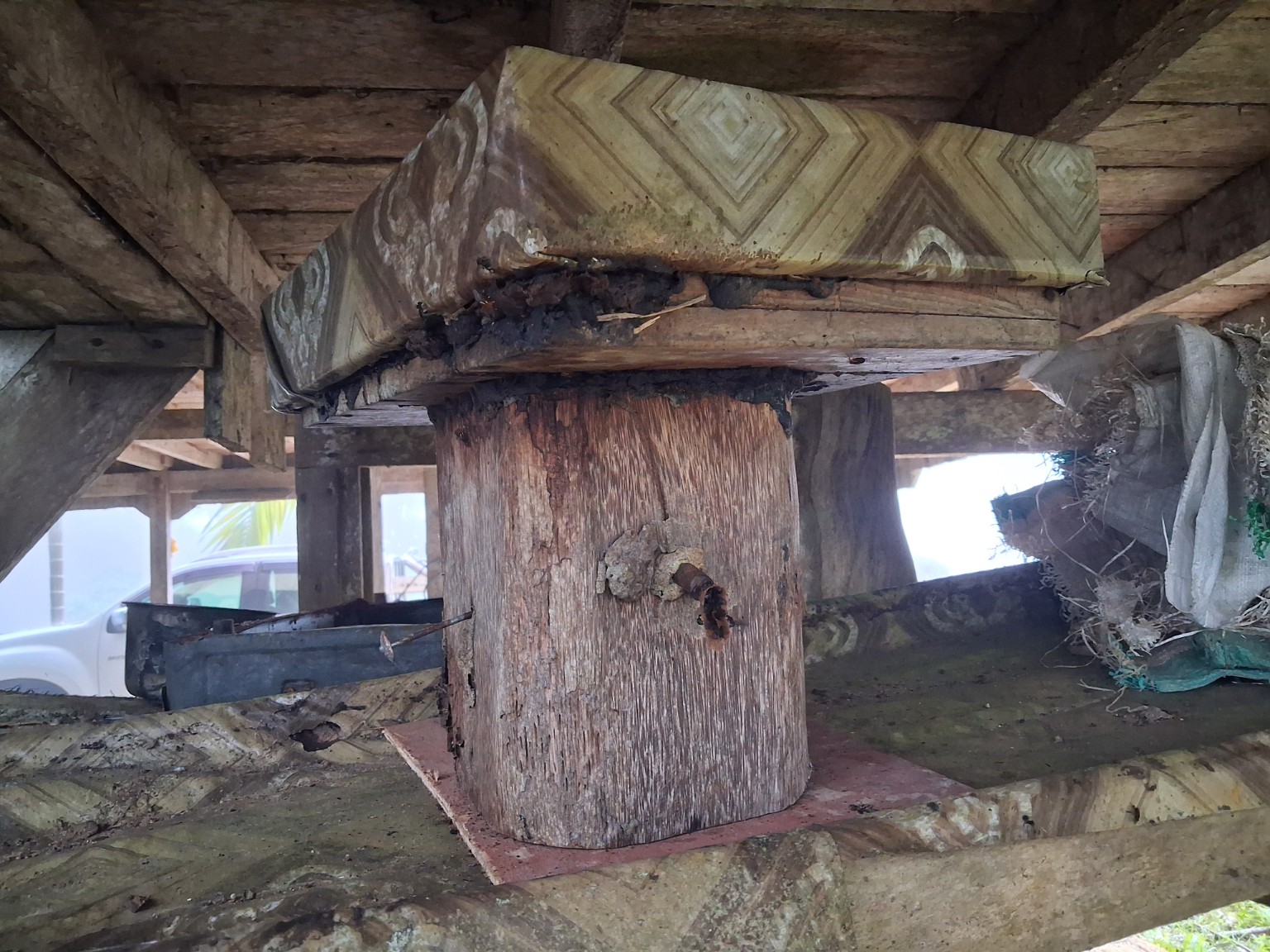
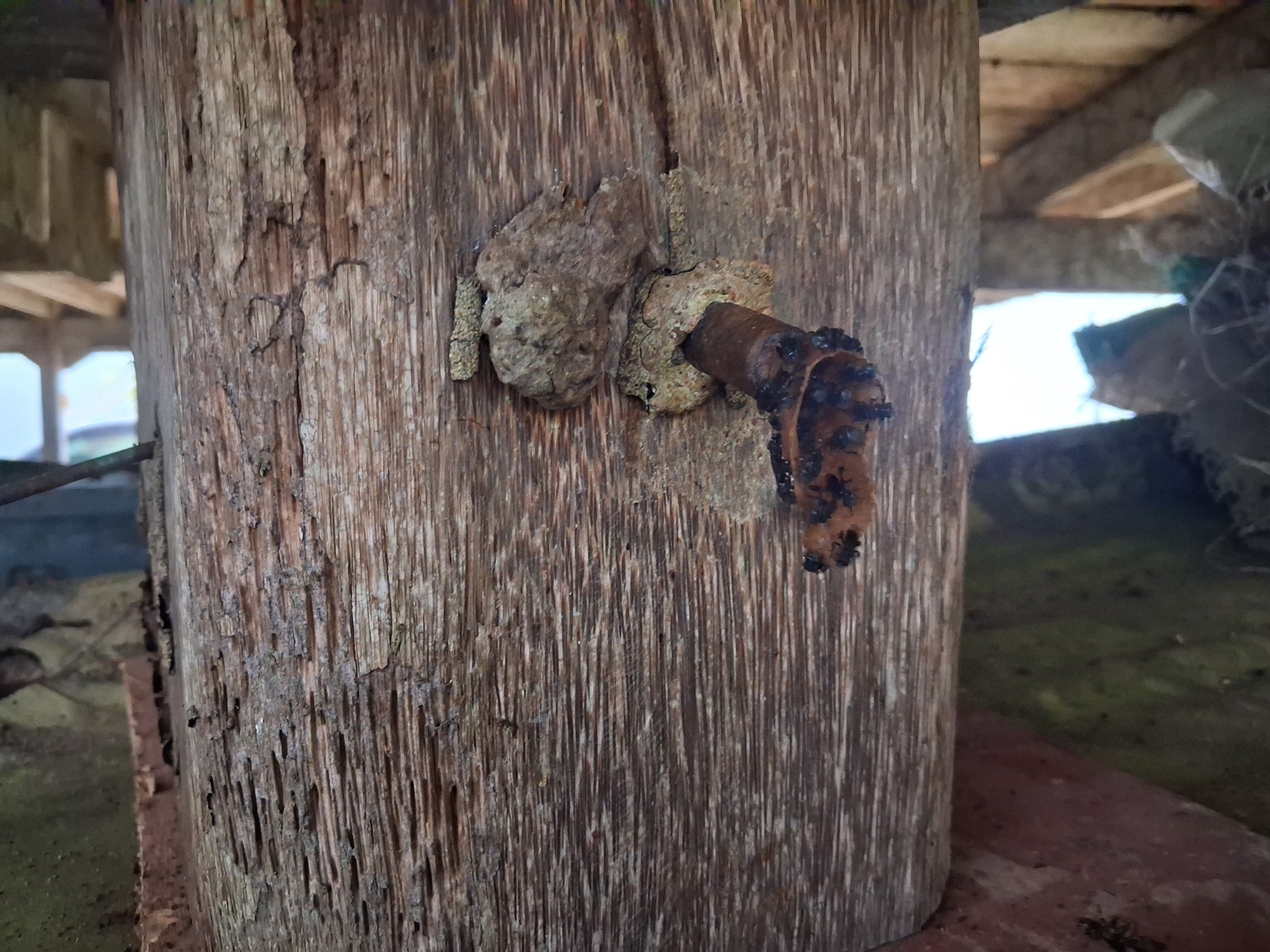
The entrance still had bees around it. That was reassuring, but it told me very little about the condition of the timber above. A colony can remain active while its housing slowly deteriorates.
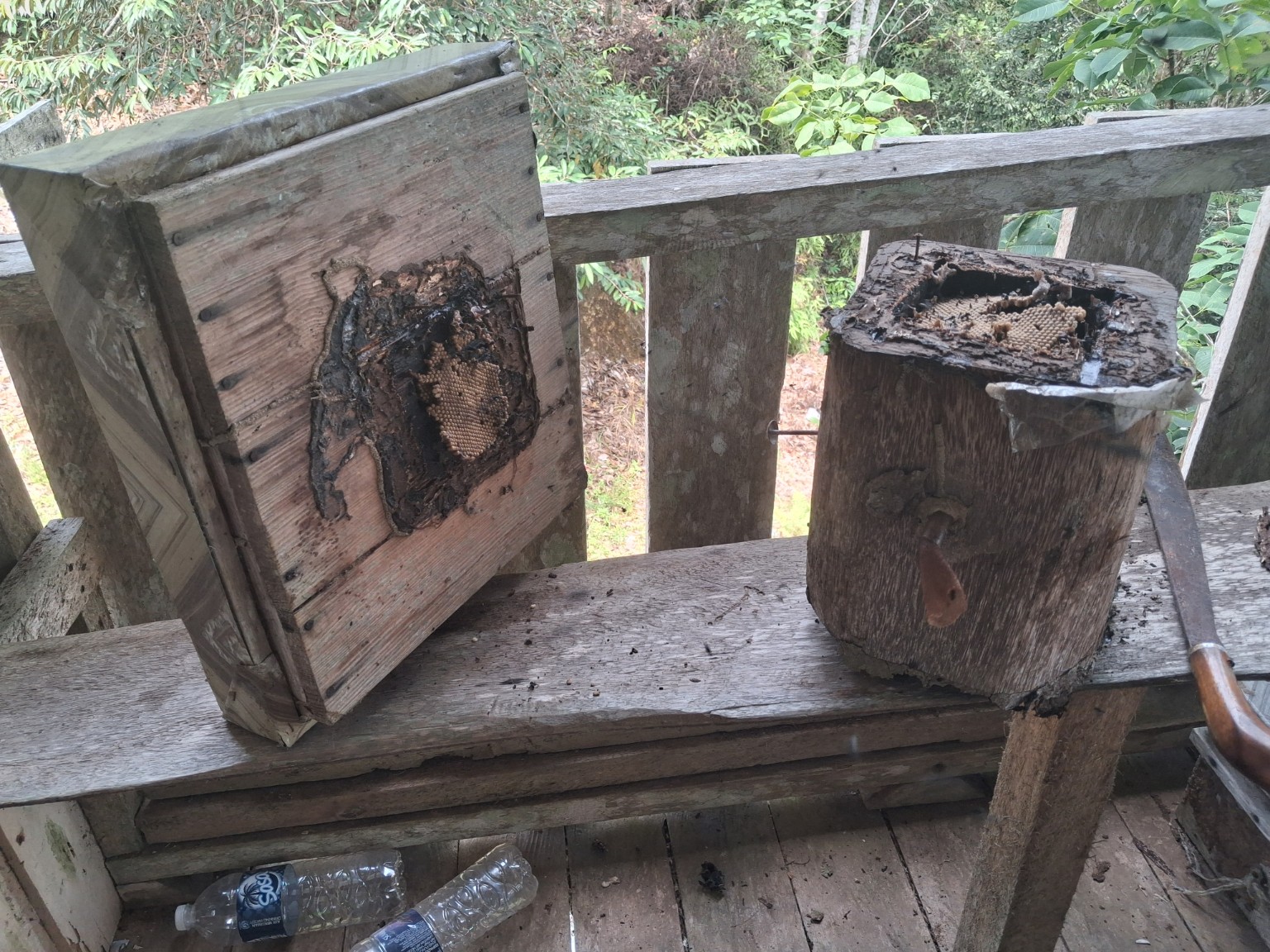
Once the topping was removed, the extent of the problem became clear. Brood had spread into the upper section, and parts of the wood were badly damaged. My photograph shows the detached topping beside the open log, with brood visible in both.
I was relieved to see so much life remaining in the nest. At the same time, I knew the box could not go back as it was. Leaving it alone again would only postpone the repair.
My Mistake With the Timber
The clearest lesson concerned the material used for the topping. The plywood or soft pine boards I had used had not held up well over the years.
For this hive, those materials proved a poor choice. The topping had rotted, and termites had begun attacking it. Even under shelter, timber needs checking. A roof overhead does not mean a wooden hive will remain sound indefinitely.
I would be more careful about choosing durable timber for another box, particularly its base and the area where it sits against the log. Those are places I now want to inspect rather than assume are fine.
This experience does not prove that every plywood box will fail. Materials, construction and exposure differ. But I would not repeat the same setup and expect a different result.
A cheaper box becomes expensive when replacing it means disturbing brood and risking an established colony.
Termites and Another Colony at the Log
The termites were worrying enough. There had also been an attempt by bees I identified as Terminata to take over the log.
I cannot explain every detail of that encounter. What I can say is that my Itama colony remained strong despite the trouble around it. I believe its strength helped it hold on, although I cannot measure how much protection that provided.
“Stingless” can make these bees sound helpless. Watching activity at the entrance gives a different impression. Their nest matters to them, and the entrance is a place worth observing closely.
Still, I should not have relied on a strong colony to compensate for damaged housing. The bees had survived. The topping had reached the point where it needed replacing.
Replacing the Topping and Moving the Brood
My first job was to remove the damaged topping and replace it with a new one. That addressed the immediate housing problem.
The brood in the old topping presented another decision. I moved it into a separate log, hoping there might be a developing queen among it and that the transferred bees could establish another colony.
That remains a hope, rather than a confirmed successful split. Moving brood does not automatically produce a queen. A new colony needs a viable reproductive future, enough workers and suitable conditions to survive.
Research on Itama propagation has found different outcomes between splitting methods, including differences in whether a new queen developed. That is why I would not describe my transfer as a guaranteed method for multiplying colonies.
For now, the honest description is that I replaced the topping and gave the displaced brood a chance in another log. Whether that attempt succeeds needs follow-up.
Why the Honey Interests People
Kelulut honey attracts interest for its flavour and its chemical composition. Research on Itama honey from Johor identified phenolic compounds and measured antioxidant activity. The results also varied with the plants visited by the bees.
Those findings are interesting, but laboratory antioxidant activity should not be presented as proof that eating the honey cures disease. Honey remains a sweet food, and its quality matters as much as its reputation.
With rotten timber and termites involved, my priority during this opening was the colony. I was not treating the situation as an ordinary honey harvest.
What I Will Do Differently
I do not need to harvest honey frequently, but I do need to check the hive. From now on, I want to pay attention to the topping, its joints and any signs of termites, alongside the bees at the entrance.
Four years without opening it was too long. This colony survived that period, and I was fortunate to find it strong enough to work with.
The new topping is one repair. Keeping an eye on it is the habit I needed to change.